
Why Centrifugal Pumps Vibrate Excessively: Causes, Inspection and Solutions
Excessive vibration in centrifugal pumps is a frequent fault in water utility pump stations, power plant circulating systems and industrial and mining water supply projects. According to maintenance statistics in the pump industry, abnormal vibration accounts for nearly 35% of unplanned pump shutdowns. Long-term vibration above the limit accelerates bearing damage, seal failure and weld cracking in piping, and in severe cases directly shuts down the unit and affects the stability of the entire water supply system.
Many maintenance teams replace the bearings as soon as vibration appears, but the problem often returns shortly afterwards because the root cause was never identified. The practical on-site inspection procedure below is organized from the simplest to the most complex causes.
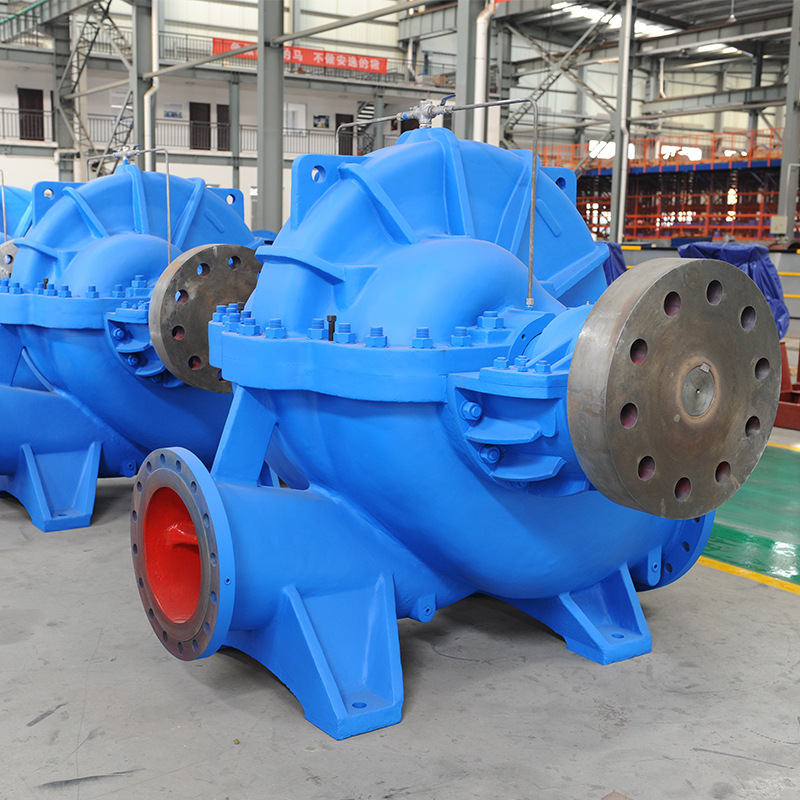
Foundation and shaft alignment errors
Installation foundation and alignment deviation is the most frequent cause of vibration. Insufficient rigidity of the concrete foundation, loose anchor bolts, corroded or collapsed shims, or misalignment between the pump shaft and the motor that exceeds the permissible radial and face deviation, as well as deformation of a common base after lifting and transportation, will all cause continuous vibration. When dealing with this, first tighten the anchor bolts, re-measure the alignment and correct it according to the deviation limits in the pump technical manual. If the foundation is soft, reinforce the base and use vibration-damping pads.
Cavitation-induced vibration and noise
When the available NPSH of the installation is lower than the required NPSH of the pump, bubbles continuously form and collapse rapidly inside the pump casing, accompanied by cracking noise and irregular vibration. Typical symptoms are reduced outlet flow, fluctuating pressure and a sound like gravel hitting the pump body. This fault is more likely when the water tank level is low, the suction line has many elbows or the inlet resistance is high. Correction measures include raising the liquid level, shortening the suction line, reducing the number of elbows and lowering the inlet resistance. Where site conditions are limited, lower the pump installation height or select an impeller hydraulic model with better cavitation resistance.
Impeller imbalance causing unit vibration
Sand and debris accumulating in the impeller passages directly shifts the rotor center of gravity. Long-term erosion creates cavitation pits and damaged blades, and solid particles in the pumped medium continuously disturb the original dynamic balance. The remedy is to dismantle and clean the passages, re-check the rotor dynamic balance, and for media containing sand, replace the impeller with a wear-resistant material.
Bearing and lubrication problems
Worn bearing rolling elements, over-greasing or under-greasing, and water-contaminated or emulsified grease all raise vibration levels. Too much grease causes churning and heat during operation, so the temperature keeps rising. Insufficient grease or water ingress leads to rapid pitting damage of the bearings. During operation, replace the lubricant strictly according to the maintenance interval, control the filling quantity, and regularly monitor bearing temperature and vibration.
Piping resonance and inadequate support
When the suction and discharge piping is rigidly connected, pipe stress pulls hard on the pump body, or suitable pipe supports are missing, the natural frequency of the piping may coincide with the unit speed and excite resonance. In such cases the pump turns freely with normal vibration, but vibration increases sharply once the unit is started, which is easily misdiagnosed as damage to the pump itself. The solution is to add pipe supports and hangers, install rubber expansion joints, release piping stress and avoid the resonance range.
Other causes
Aged or damaged coupling elastomer blocks, rotor imbalance or winding faults in the motor itself, and long-term operation of the pump at low flow in an unstable operating range.
FAQ
Q1: What vibration level is acceptable for a centrifugal pump?
A: For conventional horizontal centrifugal pumps, according to GB/T 29531, the operating vibration severity generally should not exceed 4.5 mm/s. For precision applications and large split case pumps, it should be controlled within 2.8 mm/s.
Q2: Must the pump be dismantled whenever vibration is high?
A: First carry out external checks: foundation bolts, piping, liquid level and noise characteristics. Only after external factors have been ruled out should you arrange dismantling and overhaul, so as to avoid unnecessary shutdowns.
Q3: What usually causes high vibration when a new pump is started?
A: For a new unit, first check alignment deviation after transportation, stress caused by forced pipe connection and displacement of base shims. The probability of impeller damage in a new pump is relatively low.
Vibration troubleshooting follows the sequence of "external first, internal second; piping and foundation first, rotor and bearings second." Many pump station faults do not require replacing the pump itself; correcting alignment, improving pipe support and improving suction cavitation conditions are often enough. For vibration testing, retrofit or spare parts of large split case pumps and multistage pumps, contact us with your operating parameters for technical support.